Physical copies of this zine are available at The Beguiling in Kensington Market!
January 14, 2025,
The cold darkness of the winter night pries at the thick layers I’ve bundled myself in as I leave the parking lot by Wellesley subway station. The noise of the city surrounds me: the slurry of tires cutting brackish slush in the streets; brief moments of loud conversation punctuating the sounds of sidewalk footsteps; the occasional angry honk and the crosswalk jingle singing at each changing light. I hurry along, and my feet lead me east, back to a place I knew many years ago.
I cross Queen’s Park and pass under a bridge, and suddenly, the campus opens up wide. I approach a glowing pavilion I don’t recognise built in the open space outside of Hart House, its form composed of geometric lines that are both blocky and organic all at once. I step inside, and take in all the changes around me. I feel out of place.
I wander, challenging myself to remember the way to Philosopher’s Walk. I head north, my breath clouding in the freezing temperatures, my nostrils filled with the sharp, prickly scent of winter air. Finally, I come across the meandering path that weaves alongside Trinity College.
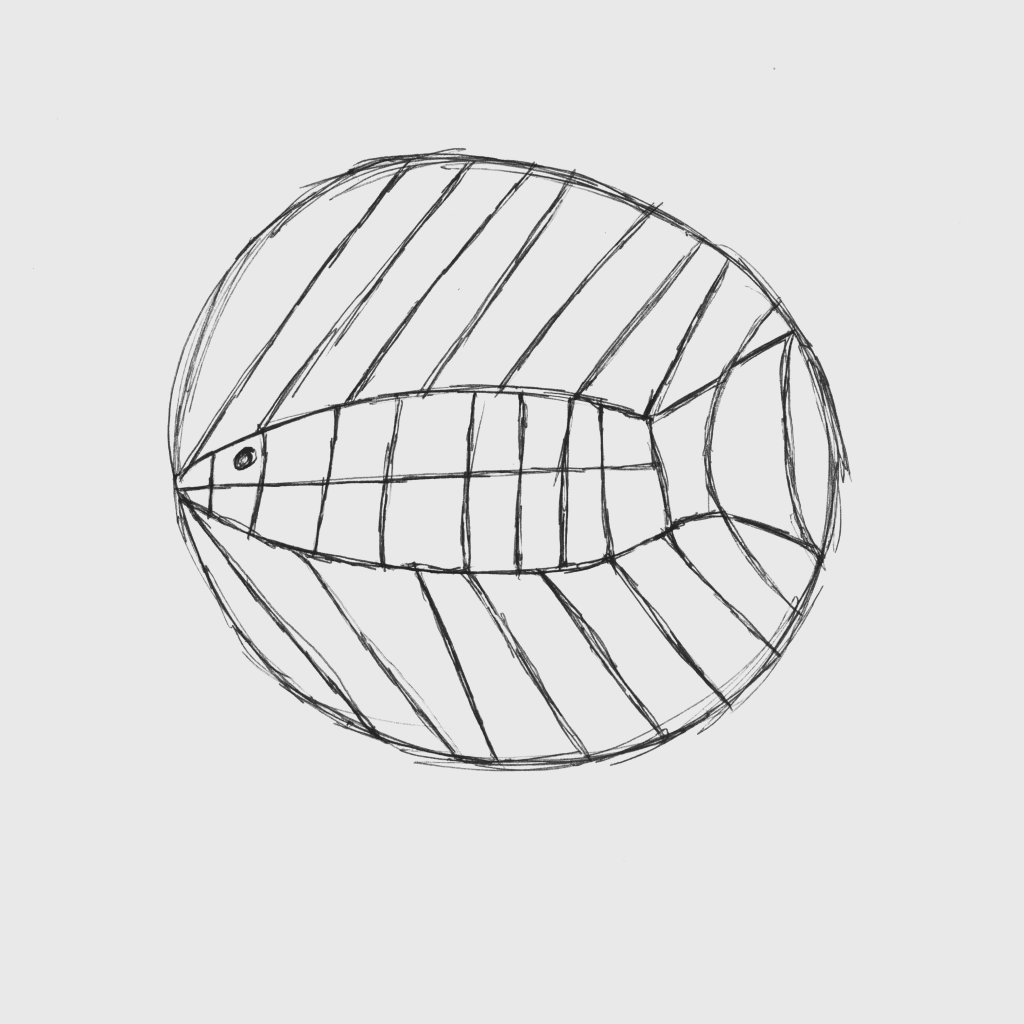
A few others pass me as I walk the trail, lamp posts leaning overhead, casting their soft circles of yellow light.The path seems hushed, like a memorial to something long past. I scan the depths of the former creek, carved out below me. My eyes find the storm drain I’ve been searching for, and I circle back. I drop to my knees, the cold seeping through my jeans, and I take it in for a moment: a cast iron grate, crafted into the likeness of a fish on its side. I listen: below the drain, no sound rises up to meet me. I peer inwards, and see nothing but darkness. I trace the outline of the fish with my gloved hand, lingering for a moment. Memories swirl.
I stand, and the current propels me forward. I walk the river bed, and for a moment, a heaviness sets in my chest. Suddenly, I feel like I am drowning. I emerge from the banks awash with emotion.
It is time to go. I wander a little longer, scanning the snowy banks for something more, some other way of connecting with the creek now redirected underground. Unsuccessful, I finally concede, and leave the grounds through Queen’s Park.

I first learned of Taddle Creek during my final year at the University of Toronto. One of my professors, Dr. Hilary Cunningham, taught us about the history of the lost rivers that once flowed through the downtown to Lake Ontario. I recall being led on a brief river walk along Philosopher’s Walk by a team from Rising Rivers, a collaborative project intended to daylight our lost rivers through neighbourhood walks that bring the stories of the past to life. I remember being led down the contours and grooves of the former Taddle Creek riverbed and closing my eyes, the feeling of a building sensation of water flowing across my feet as I walked through its memory – This was when I first met what John Borrows calls the spirit of Taddle Creek. I felt the creek’s loss acutely.
Now I’ve returned, and our situation has changed so drastically – how can I, how can we reconnect with our city’s lost past, in the wake of everything around us?
Histories: A City of Creeks
Taddle Creek is not the only waterway that has gone missing as a result of the urban development of the city of Toronto. Long ago, these lands were once a landscape shaped by many creeks and rivers, all of which fed into Lake Ontario. Archeological records show that indigenous groups have been hunting and settling in these areas for at least 11,000 years, first traveling in small bands to hunt large game like caribou, mastodon, and mammoth, then moving into seasonal settlements over time as the water levels of the Great Lakes lowered, changing the surrounding landscape. Indigenous villages began to spring up along the banks of these rivers, specifically those established by the ancestors of the Wendat and Tionontati, and the fertile soil allowed them to grow corn, squash, beans, tobacco, and sunflowers in large plots of cleared land. They also relied on the rivers for food, which were populated with many species of fish, including salmon, whitefish, and pickerel.
After the arrival of European settlers, nations of the Haudenosaunee Confederacy moved to settle near the mouths of two of Toronto’s major rivers, the Humber and Rogue, and both Europeans and indigenous nations relied on the prosperity of the rivers, including integral trade networks that wound through portage routes to and from Lake Ontario. Even the namesake of Toronto, thought to originally come from the Kanyen’kehà:ka word ‘Tkaronto’, likely refers to fishing weirs that had been constructed in these portage routes, specifically in the narrows of Lake Simcoe. The rivers, namely the Don, Rouge, and Humber and their tributaries, were an integral part of Toronto’s creation and history.
However, things changed for these creeks and rivers as European settlements expanded and dominated the waterfront. Population density began to increase at a rapid rate, and by the 1880s, the heavy influx of people and the unregulated, churning wheels of industry contributed to an ever increasing flow of raw sewage and pollution directly into Toronto’s rivers and creeks. As a result, the perspective on these waterways began to shift.
The Taddle Creek at Philosopher’s Walk, often referred to as Univeristy Creek at this time by the University of Toronto’s administration, did not escape this fate. Like many of Toronto’s creeks and rivers, Taddle Creek became a foul mixture of industrial runoff and untreated sewage, and citizens became increasingly concerned about the rank smell and the risk of water-borne illnesses, such as cholera and typhoid fever. Even considering the state of the Taddle (and the man-made McCaul Pond, which had been created by damming the Taddle on university grounds), discussions around sewering the creek were controversial. The tranquility the flow of the creek gave to many of the students and faculty was cherished, and in its final days above ground, its imminent loss was mourned through poetry published in The Varsity:
But sentimental fancies, deeds of gore,
Shall twine around thy sacred name no more,
They days are ended, and they glories o’er,
Taddle.
By 1884, the sewering of Taddle Creek was complete, leaving nothing but a memory.
The late nineteenth and early twentieth century was witness to many of these kinds of burials. The burying of creeks and rivers was often seen as a fashionable means of resolving any problem, reflecting a colonial nineteenth-century perspective of the natural world as an untamed blank canvas and destructive entity in need of ‘improvement’. However, as we know now, the burying of waterways is not without consequence. Anthropogenic changes, such as burying or rerouting a river can have complicated and outright disastrous results, as the city of Nantes, France realised all too late after burying one of the branches of the Loire river in the mid twentieth century. The loss of this branch significantly altered the flow of the river through the city, leading to bridge collapses, erosion of retaining walls, and the caving in of buildings built along the waterfront. Although less immediate, the loss of Toronto’s many creeks, and the alteration of its major rivers is felt through the flooding of basements and backyards, of overwhelmed sewers drowning streets and sidewalks, and the loss of habitat biodiversity that once managed the ebb and flow of water and enriched the land.
Thankfully, the consequences of the loss of Toronto’s creeks has not gone unnoticed. Various groups have been calling for the acknowledgement of the legacy of lost rivers for years, like our guides from Rivers Rising. Many even hold the hope that lost creeks, such as Taddle Creek, may eventually be opened up again, to see the sky.
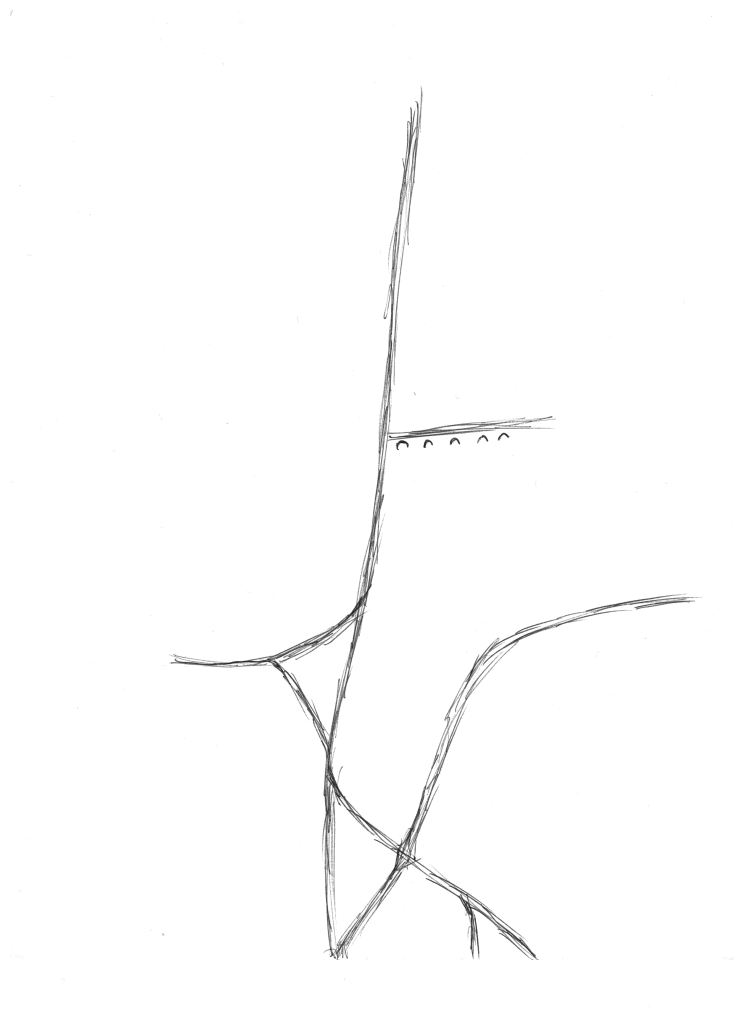
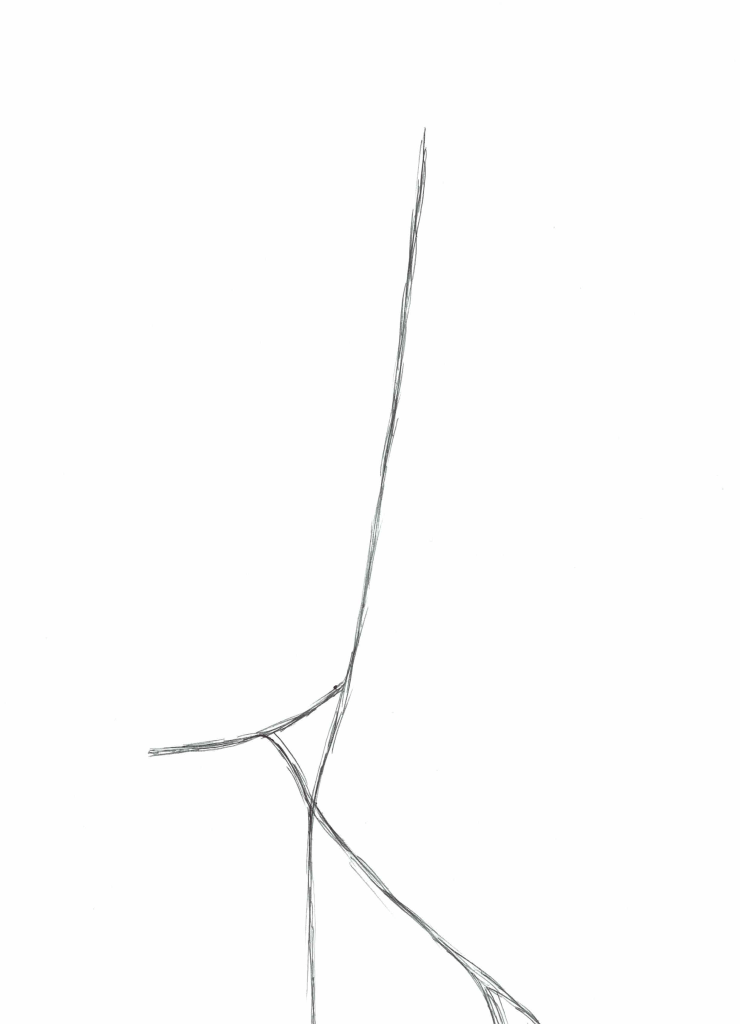
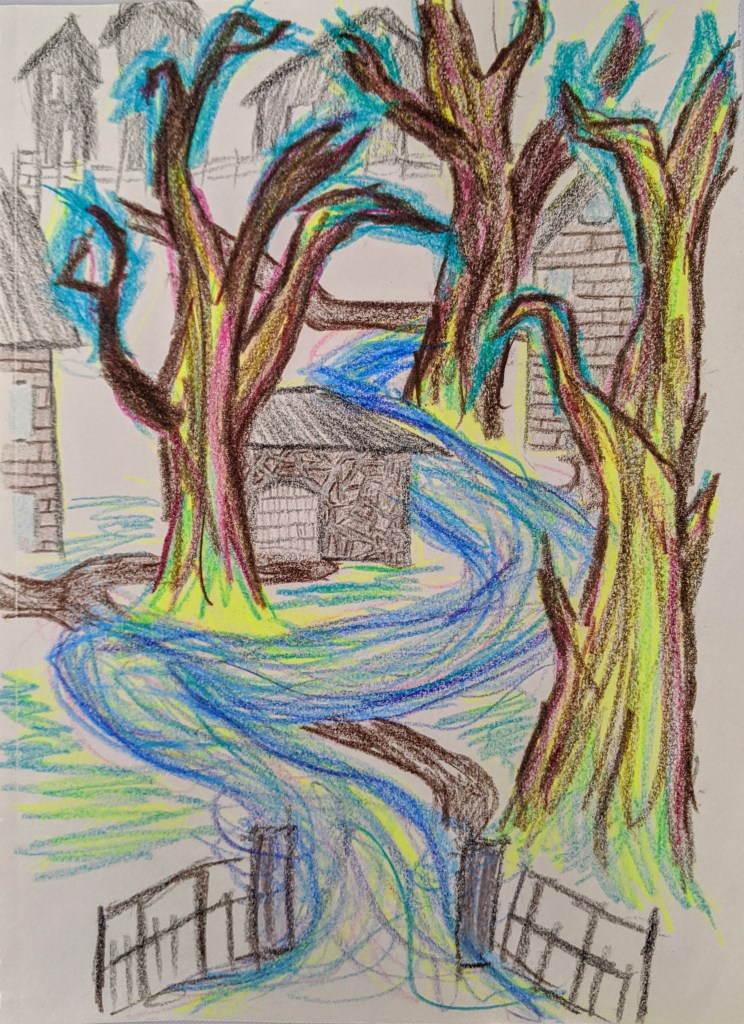
Sketch of Philosopher’s Walk in 1965.
Histories: Defiant Encounters
After the sewering of Taddle Creek, Philosopher’s Walk didn’t disappear. People continued to walk the pathway while travelling through campus, although the scenic appeal of the creek was now gone. Philosopher’s Walk also continued to be an important meeting place for a certain community, who now relied on the foliage and obscurity of the path for its discretion.
Cruising, or seeking out sexual encounters in public spaces, has always been a part of Toronto’s history. Gross indecency trials dating back to the end of the nineteenth century show that men have been finding each other in the dark corners of Toronto for well over a hundred and fifty years. Philosopher’s Walk was one such cruising hotspot – local tabloids throughout the 50s, 60s, and 70s regularly reported on the “shadowy figures” of men cruising late at night along the walk. Although these reports framed cruising men as predators on the hunt, prowling in the shadows, the reality is that cruisers had more to fear from the public than the public did from them. University students were known to regularly target cruisers along Philosopher’s Walk in a variety of cruel ways, ‘baiting’ the cruising men by flirting in order to encourage them to let their guard down. Once a student had lured in a suspected cruiser, other students waiting quietly nearby would descend on the man, beating and robbing him before escaping into the night, leaving the man bleeding in the bushes. And students weren’t the only ones targeting men along the path – plainclothes police officers were known to use similar strategies at cruising hotspots like Philosopher’s Walk, inviting men by engaging in well known coded behaviours, only to arrest them under charges of indecency once the man had acted on the invitation.
It’s worth remembering that until 1969, displaying homosexuality was outright illegal (and only then, decriminalized with restrictions). Men who were attracted to other men weren’t openly accepted by the general public, and often lived their homosexual lives in secret. Of course, there were also no smartphone apps or online chat rooms in the mid twentieth century, meaning that cruising was one of the only ways men could find the queer connections they craved. Late night meeting places, such as Philosopher’s Walk, served as an important lifeline for this community.
However, the mid twentieth century also brought significant changes to the landscape of Philosopher’s Walk. A cultural shift was underway, and a keen interest in sustainability and celebrating our natural world worked its way into new designs planned for the university’s downtown campus. Landscape architect Michael Hough, known now for his biophilic urban designs found in Toronto and beyond, was hired to redesign the pathway in order to recall the greatness of the creek that once ran through the university grounds. Construction on Hough’s plan for the walk began in 1961, reshaping the pathway to include grading changes, tree and bush plantings, the replacement of concrete ditches with sodded swales, and the removal of a long, iron fence that prevented strollers from travelling from Philosopher’s Walk to the university’s newly acquired Flavelle House. By 1965, Hough’s vision for Philosopher’s Walk had been realised: the pathway had been fully transformed.
But even after the walk’s redesign, students, faculty, and the public continued to complain about the presence of cruisers in the park. Hough’s design included new foliage plantings, such as forsythia, which filled in over the coming years, creating a lush but dense forested area. It would only be a few years later, in 1968, that Philosopher’s Walk was altered yet again – the university installed new lighting and had the park defoliated, cutting away most of the bushes to discourage these late night rendezvous.
This is not an unusual progression for public spaces. Parks are often altered in order to prevent “undesirables” from enjoying them in so-called unintended ways – for example, it’s common for public spaces to have brush cleared to create better sightlines, or for additional lighting to be installed to discourage sexual activity. Much of this strategy arises from a social purity movement that took hold during the early twentieth century that emphasized controlling others’ behaviour in public settings, such as parks. But do these changes really make our public spaces better?
Philosopher’s Walk continued to be an important meeting place for cruisers for years to come, regardless of these changes. Safety concerns about the pathway were also still regularly reported by university students, who called for a more attentive security presence after more than one female student was sexually assaulted while travelling through it. Considering this, is it time to re-examine our preconceived notions about who should be using our public spaces, and how we should be shaping them in response?
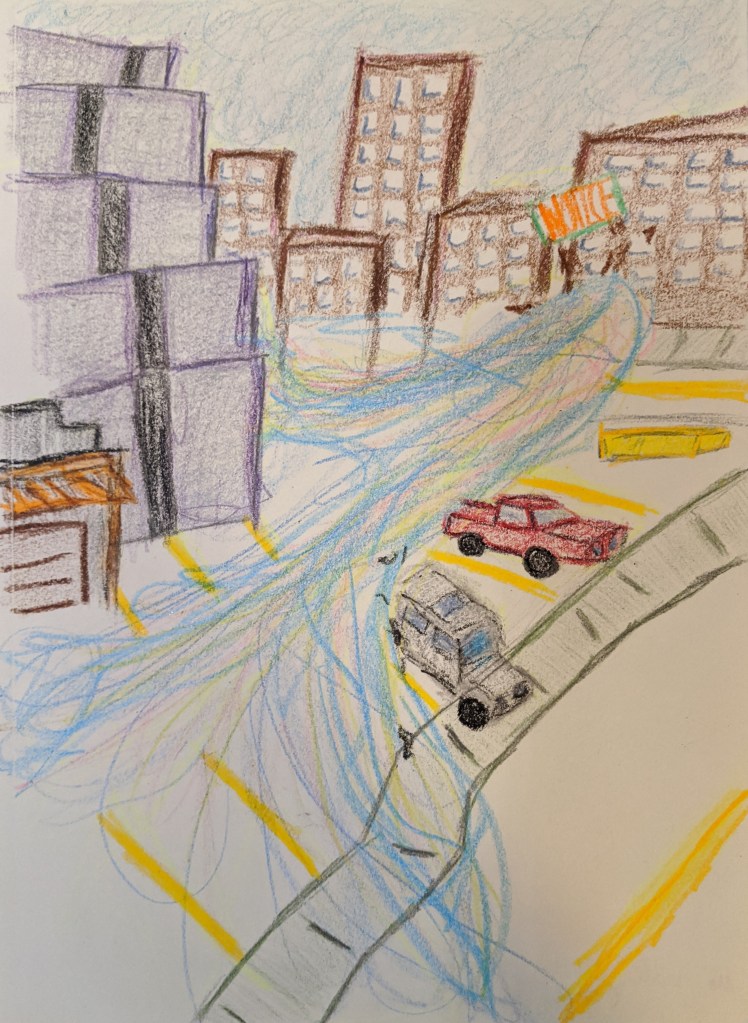
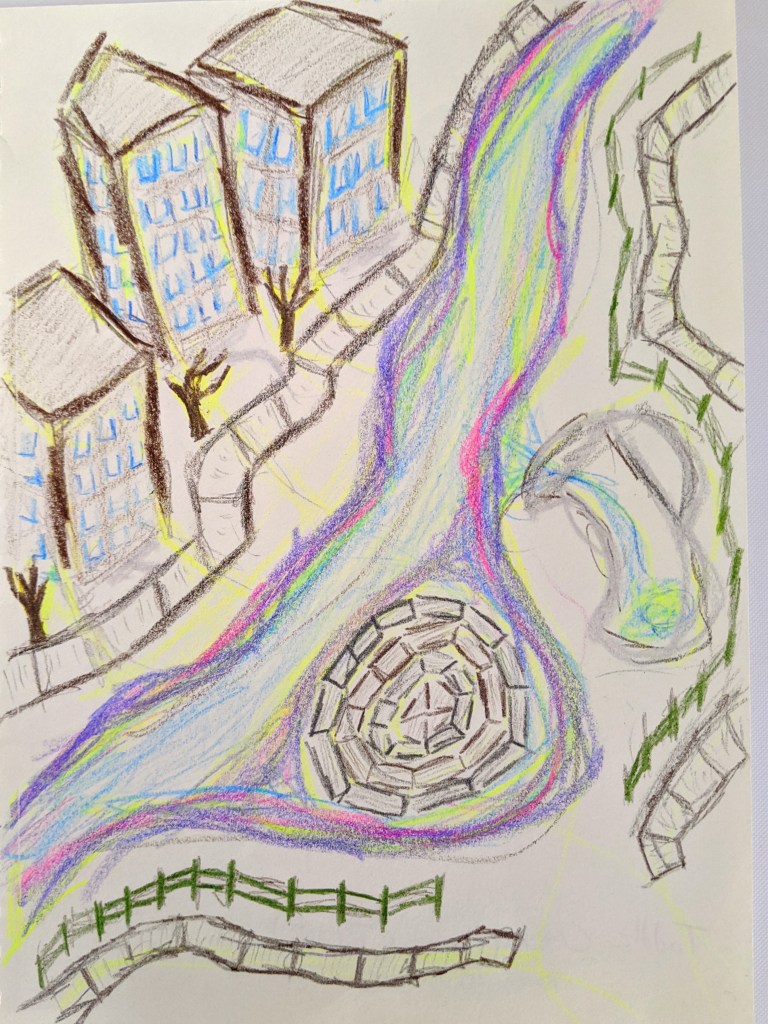
Colour Sketch of Taddle Creek Across from Moss Park, Southwest Corner of Queen St. E & Jarvis St. (Toronto), February 5,2020.
A Moment of Reflection: Seeing the Colours of Ziibiing
I have walked Philosopher’s Walk countless times since the beginning of this zine. Each time, I am rewarded with yet another unfolding of the many currents of history running through this place. I am moved by the sheer will of this creek, to constantly make itself known regardless of so many years of stifling, as well as the deep love so many different people have had for this pathway that meanders between the institutions that have built up around it.
Through my research, I’ve discovered another name for Taddle Creek: the Anishinaabemowin word Ziibiing, meaning ‘at the river’. Ziibiing was, and still is, a sacred meeting place for indigenous communities. Although the creek’s waters now flow underground, the spirit of Ziibiing lives on: the new pavilion I was drawn to during my first return to the campus is a recent realisation of indigenous placemaking. Called Ziibiing, it sits upon the creek’s previous riverbed south of Philosopher’s Walk, and honours the area as a sacred meeting place and a celebration of indigenous heritage. The pavilion, just recently opened in September 2024, provides a space for land-based teaching, as well as traditional native gardens and architectural features that encourage collected rainwater to flow in ways that remember the presence of the former creek.
I am thankful for the experiences of Ziibiing and Philosopher’s Walk, which have taught me what resiliency looks like in the face of struggle and uncertainty. We deserve to be known. We deserve to take up space. Like Ziibiing, we must find constant and creative ways to communicate who we are when our flow is stymied by the forces that be.
In Drawn To See, anthropologist Andrew Causey suggests that when we observe our surroundings, we may actually not be seeing them. He encourages us to challenge ourselves to see better, by bringing our world to life through the art of line drawing. He argues that drawing is a fearless act, one that everyone should dare to embrace. My own gift to Ziibiing can be experienced throughout this zine, in the colourful hand drawings I’ve made of the creek’s spirit flowing through different Toronto landscapes before it was sewered. Drawing, then, can be not just a window into the past, but also to possible futures.
So, reader, look around. What do you see?
Perhaps it’s time to pick up a pen, and draw.
Tributaries
Bernstien, Jaela, and Emily Chung. 2024. “Discover Where Ancient Rivers Flow Under Canadian Cities.” CBC News, April 3, 2024. https://newsinteractives.cbc.ca/features/2024/daylighting-rivers/.
Borrows, John. 2002. Recovering Canada: The Resurgence of Indigenous Law. University of Toronto Press.
Brown, James, and Kim Storey. 2008. “Buried Alive: Garrison Creek as a Rediscovered Extended Waterfront.” In HTO: Toronto’s Water from Lake Iroquois to Lost Rivers to Low-Flow Toilets, 204–11. Toronto: Coach House Books.
Causey, Andrew. 2017. Drawn To See: Drawing as an Ethnographic Method. University of Toronto Press.

City of Toronto. 1961. “Aerial Photographs 1961, #65.” City of Toronto Archives. https://www.toronto.ca/ext/archives/s0012/fl1961/s0012_fl1961_it0065.jpg.
Dean, Heather. 1964. “The Varsity Sport Nobody Reports (Sports Section).” Gargoyle Magazine (University of Toronto), September 29, 1964. The Arquives.
Desfor, Gene, and Jennifer Bonnell. 2013. “Planning Nature and the City: Toronto’s Lower Don River and Port Lands.” In Urban Explorations: Environmental Histories of the Toronto Region, 164–86. Hamilton: Wilson Institute for Canadian History.
Gaylord, Duke. 1968. “The Gay Set.” TAB, September 28, 1968. The Arquives.
Georgiou, Bob. 2023. “When Taddle Creek Stank.” In The Big Book of Spacing: 20 Years of Uncovering Toronto’s Unique Urbanism, 200–202. Toronto: Spacing Media Inc.
Hobbs, Peter, and Cate Sandilands. 2013. “Queen’s Park and Other Stories: Toronto’s Queer Ecologies.” In Urban Explorations: Environmental Histories of the Toronto Region, 73–94. Wilson Institute for Canadian History.
Hough, Michael. 2004. Cities & Natural Process: A Basis for Sustainability. Second Edition. Routledge (Taylor & Francis Group).
Hough, Michael, and ENVision. 1963. St. George Campus, Master Plan,Prints #2 (Seeding, Sodding, and Planting Plan). St. George Campus, Master Plan, Originals. Archives of Ontario.
Massard-Guilbaud, Genevieve. 2017. “The City Whose Rivers Disappeared: Nantes, 1850-1950.” In Rivers Lost, Rivers Regained: Rethinking City-River Relations, 85–106. Pittsburgh: University of Pittsburgh Press.
McCann, Marcus. 2023. “Indecency: A History.” In Park Cruising: What Happens When We Wander Off The Path, 135–64. Toronto: House of Anansi Press Inc.
“‘Nature Inspires Curiosity’: Using Land-Based Learning to Explore Indigenous Histories and World Views at Ziibiing.” 2024. University of Toronto: The Division of People Strategy, Equity & Culture News (blog). August 20, 2024. https://people.utoronto.ca/news/using-land-based-learning-to-explore-indigenous-histories-and-world-views-at-ziibiing/.
Rivers Rising (Guides Nolan & Ion), Hilary Cunningham, and Helen Mills. 2019. “Lost Rivers/ Rivers Rising/Forests.” River Walk/Lecture presented at the ANT 450: Nature, Culture, City, University of Toronto, October 21. http://www.torontogreen.ca/what-we-do/rivers-rising/.
Sousa, Eduardo. 2008. “Re-Inhabiting Taddle Creek.” In HTO: Toronto’s Water from Lake Iroquois to Lost Rivers to Low-Flow Toilets, 234–47. Toronto: Coach House Books.
TAB. 1972. “Pansies Bloom By Night Along U. of T. Philosopher’s Walk,” June 10, 1972. The Arquives.
Taylor, Tatum. 2017. “Wilde and Urban Wilderness: Defining Public Space in Allan Gardens.” In Any Other Way: How Toronto Got Queer, 57–60. Coach House Books.
The Varsity. 1956. “Police Crack Down on Walk: Twelve Night Prowlers Arrested for Indecency,” January 17, 1956. The Arquives.
Toronto Daily Star. 1979. “No Vigilantes,” November 12, 1979. The Arquives.
Williamson, Ronald F., and Robert I. MacDonald. 2008. “A Resource Like No Other: Understanding The 11,000-Year Relationship Between People and Water.” In HTO: Toronto’s Water from Lake Iroquois to Lost Rivers to Low-Flow Toilets, 42–51. Toronto: Coach House Books.
 A Worn Journal of Fieldnotes