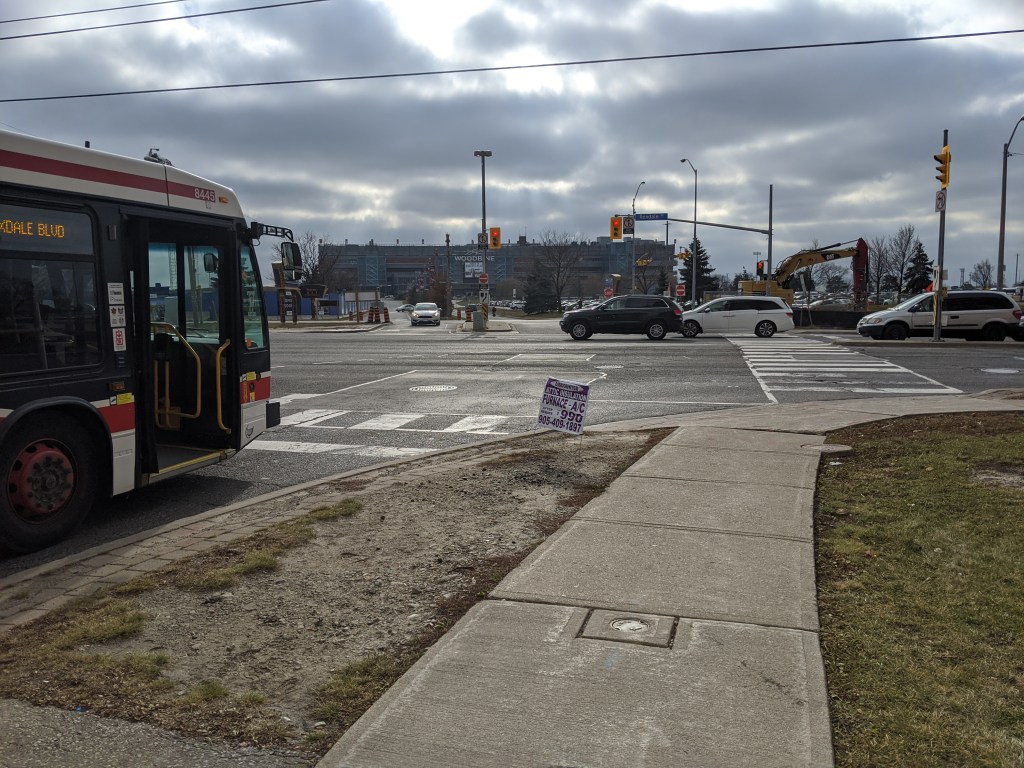
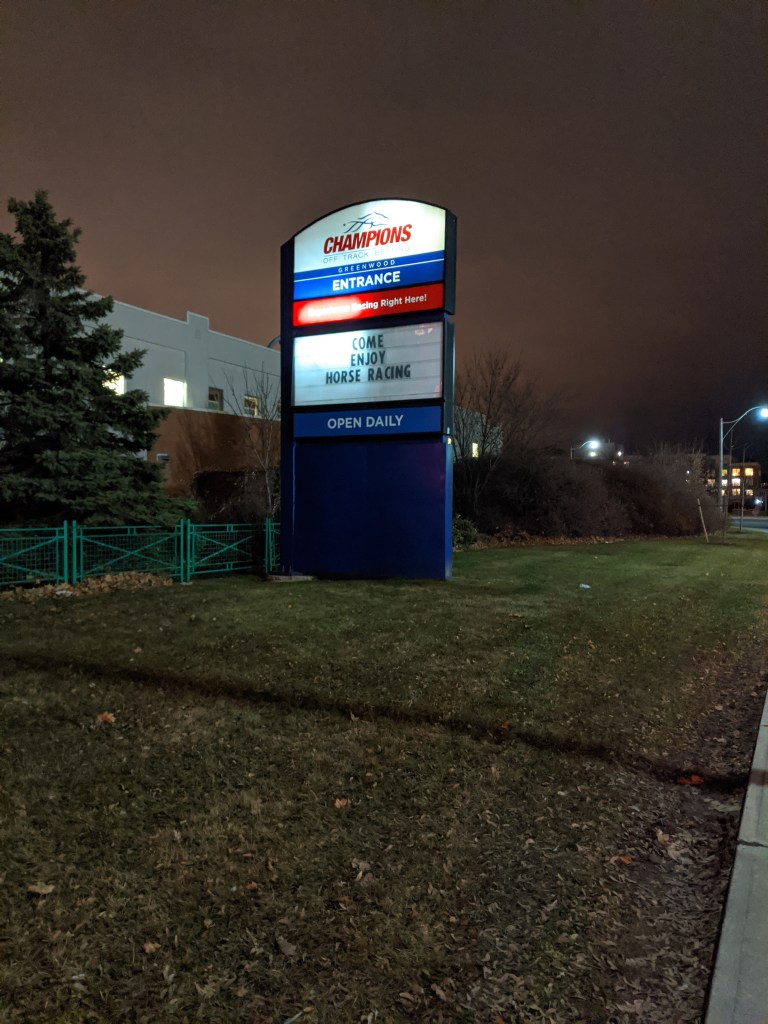
Taylor Thompson, “Woodbine Racetrack Entrance (Etobicoke),” November 30, 2019.
Nov. 30, 2019
I am standing on the curb of Rexdale blvd. and Queens Plate dr., just after arriving by bus. The day is brisk, and the clouds are overcast, but the occasional sunbeam cuts through the cover. All around me are the sounds of vehicles: buses hiss and snort as they offload their passengers, cars and trucks squeal and honk at each other, at distant altitudes commercial jets leaving the Toronto Pearson Airport whistle past above. In front of me, I see a landscape of parking lots, filled and swarming; cranes sit behind high walls, quietly doing their work away from prying eyes; and a building – a low rectangle, that somehow commands more power that it should.
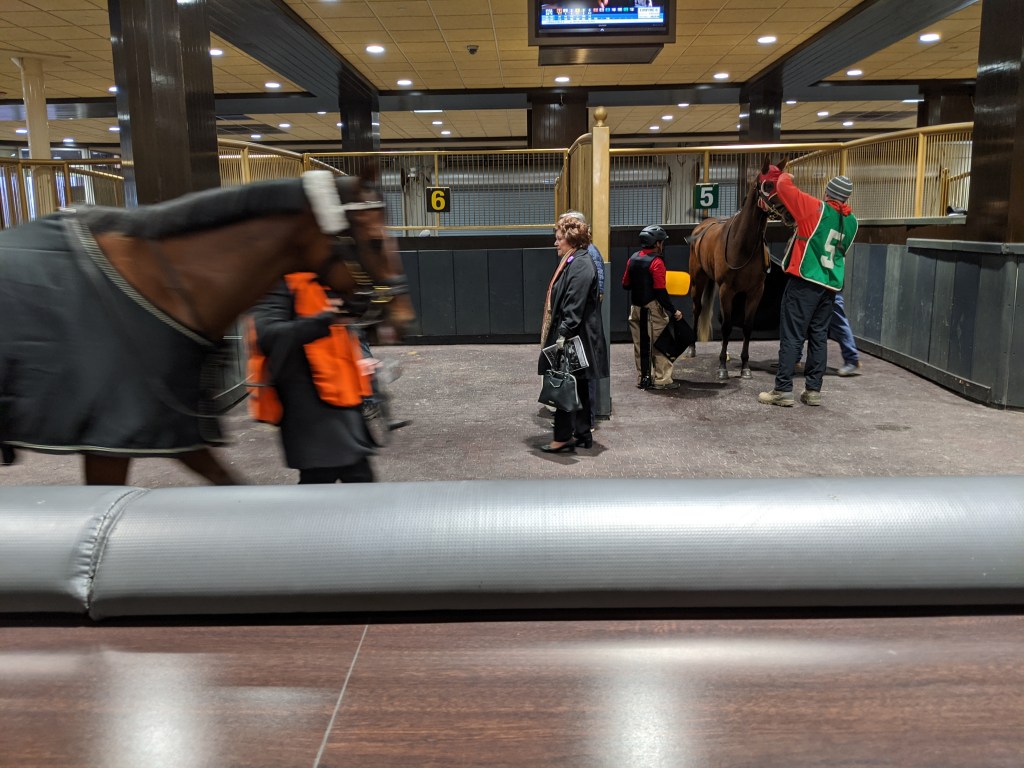
I make my way inside, and am surrounded by horses: horses in advertisements, running with jockeys; horses on televised screens competing in races, or about to; plush toy horses in display cases, pointing to a gift shop to buy your own; even a dedicated horse hall of fame, which runs through a long hallway and ends in an open-ended room. I see plaques dedicated to famous horses such as Secretariat, who raced his last race here in 1973, before retiring (WEG n.d.) and the Canadian horse, Northern Dancer.
Taking the escalator, I find the seating and betting area for the outdoor horse track, which runs a giant oval in front of us. All around me are sounds of excitement and exchange: coins dropping and rolling on the floor, a voice announcing horse names and race times. The track is decorated with ponds and some carefully curated trees. I take a seat and wait for the races to start.
To warm up, horses with jockeys are trotting in twos around the track. My púca* joins me, seating himself next to me. He does his best human impression, nodding and tipping a hat before straightening his own betting papers, and I try not to smile. Then he crosses his legs, kicking up a hoof. I hear the name of the leading horse, Simply Mysterious.
Simply Mysterious, that’s gotta be our boy, I say, and my púca smirks at me.
The race begins and I barely notice – it’s sudden, and with little warning. But then the riders pass in front of me, and my eyes are glued. I watch their technique – I know how to ride a horse, so I feel their movement, the sharing of energy between jockey and horse as they buckle and surge.
As they close in on the finish line, there’s a building in the room: a chorus of yelling, slapping, and muttering of prayer to the powers that be to add the ingredient of luck: One in three odds! One in the three Odds! Come on! Come On! One In Three Odds! My chest tightens as I feel the energy of the audience – I’ve also run in races before. I feel the scrutiny and the excitement of a crowd, all animated around this cyclical event of chance.
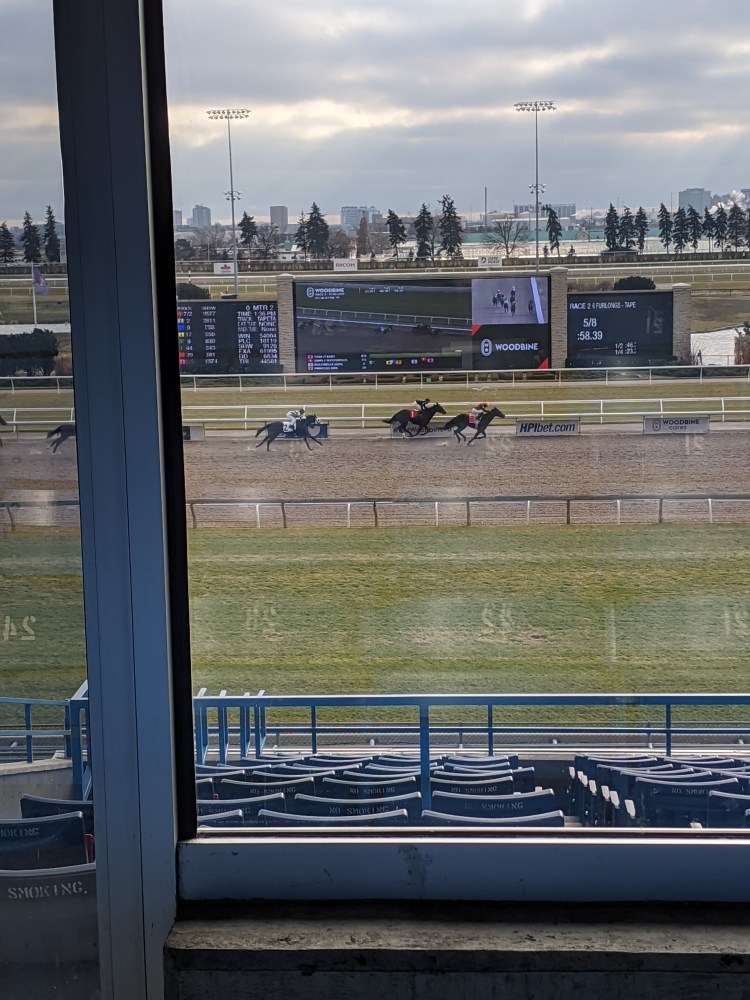
Then it’s over. Simply Mysterious, our boy, comes in second behind a horse named Take It Easy. As the energy around me disperses, I laugh quietly and shrug.
Ah! Maybe better luck next time… I say, but my púca’s already tossing the butt of a nonexistent, hand rolled cigarette off somewhere into the stands and turning away. He leans towards the exit, and I nod. Time to move on.
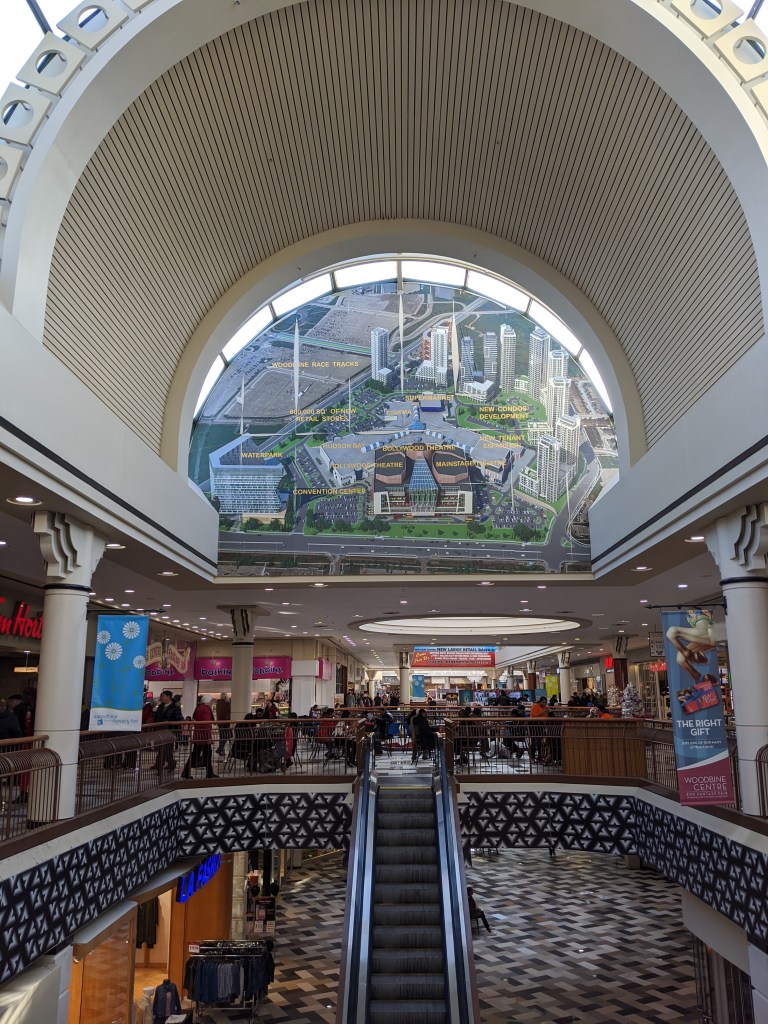
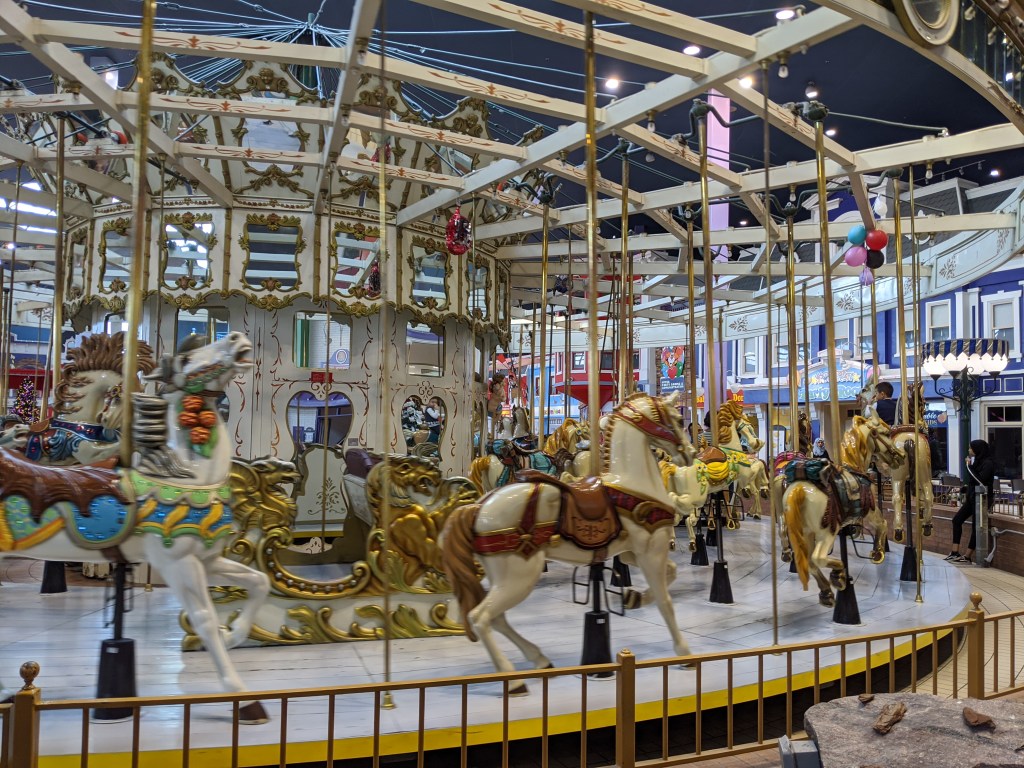
We head to the Woodbine Centre across the street, a strip mall known for its ‘Fantasy Fair’ indoor amusement park. Here, there are carousels, animatronics, rides – giant dinosaurs roar and snap, animals like tigers suddenly come to life without notice, crowds of families fill the room with bustling energy and the excitement of play. It was as if somehow modernity had been preserved, the dream of a good life was a bubble that had yet to burst (Berlant 2011). Above, unlabeled development plans display a future that includes a water park, condominiums, and an expanded Woodbine Racetrack. It’s as if us visitors to the Woodbine Centre are being led to believe that this plan, almost cartoonish in nature, would simply erect itself, for the sake of our convenience.
Relationships
At a recent point in my past, I lived here in Etobicoke by the Woodbine Racetrack for five years. Not once did I ever enter it.
Recent changes to the area are evident to me: the Woodbine Centre is noticeably shinier, and previously empty storefronts are filled. The addition of animatronics, including motorized, rideable horses for children to tour the mall with, is a recent one. Something about the Woodbine Centre feels like it’s now pointing to something, whereas previously, it often felt neglected, as if left to sag.
Northern Etobicoke, in its relationship to Toronto, is mixed. As a previous resident of northern Etobicoke, I felt largely separate from the rest of the city – transit options were scarce, city maps often didn’t acknowledge northern Etobicoke, friends and acquaintances laughed more than once while reassuring me we weren’t ‘really living in the city’. What I suspect they meant was that northern Etobicoke was not just spatially distant, but in fact a piece of Toronto that just really didn’t ‘fit’ – similar to Scarborough, it was relatively impoverished, it ‘lacked culture’ that was needed to incorporate it into the city, it was too racialized, too aesthetically downtrodden, not progressive enough. North Etobicoke fell into the liminal space between the urban centre, and the suburban surrounding area, complicating cultural distinctions that create the sub/urban divide.
But north Etobicoke is also filled with incredible beauty. I recall the winding trails surrounding Humber College that I used to walk, the bridge made of wooden planks that crossed the Humber River that I used to linger on. I can still remember the wild grasses of the Humber Trail, that seemed to explode from the periphery; the rapid drum beat of bike tires on boards of wood as cyclists passed behind me as I gazed into the river waters. Its unkempt wilderness fed my soul while my feet brought me temporary escape from my problems at home.
But these recent changes leave me uncertain. Are these changes promising for humans, nonhuman animals, and the surrounding local environment?
Critical Analysis: Horse/Human Lifeways and Private Development
The relationships created through the Woodbine Racetrack form a kind of lifeway, or an expression of what Cunningham and Scharper call “the cultural, aesthetic, and cosmological integration of the urban within a biotic community of the human and non-humans” (2014, 496). Lifeway suggests that “a dynamic of mutual dependency” is an integral feature to being a living being in relation to other living beings, who make up the worlds we live in (Cunningham and Scharper 2014, 496). The Woodbine Racetrack brings us into relationship with nonhuman animals, where they are awarded a limited kind of personhood for the sake of human entertainment. Horses like Secretariat and Simply Mysterious play an important role in human/nonhuman dynamics of mutual dependency by providing their audience with sensations of hope, excitement, and collective participation.
However, the past of the urban centre of Toronto reveals another kind of horse/human lifeway. Nineteenth century Toronto was teeming with nonhuman animals, who were literally “roaming streets and lanes, hauling freight, and living in backyard stables” (Kheraj 2013, 123). This included an array of horses, cows, pigs, and chickens in addition to the cats and dogs we often experience today. As a result, nineteenth century Toronto, in contrast to twentieth and twenty first century Toronto, engaged in this dynamic of mutual dependency by accommodating both human and nonhuman animals, as they were understood to be “absolutely vital to the functions of a growing city and central to the lives of ordinary Canadians” (Kheraj 2017, 310). This was reflected in the regulation of these animals, which critically considered their health and wellbeing in relation to the value they produced for humans, for example the use of “soft street pavements” which were “designed to accommodate hooves as much as wheels” (Kheraj 2017, 311;2013, 123). However, as urban centres adopted technologies such as electrified street railways and moved towards accommodating the automobile, domesticated nonhuman animals became less present, and as industrial meatpacking factories began to take over the process of slaughtering and butchering animals, urban residents increasingly began to rely on sliced and pre-packaged meats, further removing the need to keep and experience domesticated nonhuman animals (Kheraj 2013, 123). The animals we encounter now within the Toronto urban landscape tend to be those we label ‘wild’, for example raccoons, pigeons, and the occasional urban coyote (Grady 1995; Kheraj 2017).
The Woodbine Racetrack, as one of these last places to engage with the domesticated, nonhuman animals who once joined us in the downtown streets, represents what Cunningham and Scharper call a “private ecology” – although entrance into the racetrack is free, the facility is privatized and owned by the Woodbine Entertainment Group, which winds its way through the city of Toronto, as well as nationally into cities such as Vancouver (2014; WEG n.d.). In March 2019, the Ontario Government pledged $10 million dollars annually to “support breeding and industry development for Ontario-bred horses” (TCP 2019). Only two years previous, the Woodbine Entertainment Group shared their $10 million dollar ‘Master Plan’ to incorporate what is quite literally “a city within a city” – creating an urban centre that is owned and maintained by one corporate group (WEG 2017). This may sound promising to some, but as Cunningham and Scharper warn:
“The rise of cities across the globe in the last century has been accompanied by a rise in transnational corporate power. This has led to a type of privatization of ecologies in urban centers – something that has been ecologically destructive, since “private ecology” is designed to maximize corporate profits regardless of the common good.” (2014, 493)
Importantly, the spectacle is key to creating a sense of identity to a place, as well as engendering certain social mores – for example, in her book Electric Dreamland, Rabinovitz traces the history of amusement parks, cinema, and modernity, revealing the effect the Walt Disney Company had in homogenizing and sanitizing the image of the amusement park, emphasizing the values of “cleanliness, order, and efficiency” (2012, 164). As the Walt Disney Company has come to monopolize much of our entertainment, we see these values, rooted in imperialism and white supremacy**, becoming the relative standard of our mass consumed stories. Considering these effects at a local scale, the privatization of mass urban spaces such as the WEG’s ‘Master Plan’ become a worrisome point of contention in the urbanisation of Toronto, for human and nonhuman animals alike.
A Moment of Reflection: Further Adventures
There is joy in hard-to-find places. A few bucks on a horse race can bring a glimpse of a good life, of happiness, of some collective thing that brings us together for some moment in time. Spectacles of modernity may numb us to the crises of the twenty first century, but they may also strike us with wonder, as artifacts devoted to human play and experience. Any ethics of justice must also be concerned with ethics of happiness.
My relationship to the Woodbine Racetrack remains unfinished. As conglomerates of all sizes continue to privatize our spaces and institutions, I grow incredibly wary of spaces like the Woodbine Racetrack and the WEG’s other extensions. Spaces like the Woodbine Racetrack, The Woodbine Centre, and the Woodbine Entertainment Group’s various extensions can be enjoyed, but we must always critically attend to the motivations and histories behind our entertainment.
Notes
*púca are shape-changing fairies, who have an ambivalent, but often playful relationship with humans. They are of Irish/Celtic heritage (Breatnach 1993). They like to play tricks, but seem for the most part to not intend to harm, and can bring good luck as well as bad luck.
**For the curious and worried soul, I recommend beginning with a copy of How To Read Donald Duck: Imperialist Ideology in the Disney Comic (Dorfman and Mattelart 2018).
Bibliography
Cunningham, Hilary, and Stephen Bede Scharper. 2014. “Futures: Lifeform, Livelihood, and Lifeway.” In A Companion to Urban Anthropology, edited by Donald M. Nonini, 486–97. John Wiley & Sons, Ltd.
Dorfman, Ariel, and Armand Mattelart. 2018. How To Read Donald Duck: Imperialist Ideology in the Disney Comic. Translated by David Kunzle. New York ; London: OR Books.
Grady, Wayne. 1995. Toronto The Wild: Field Notes of an Urban Naturalist. Toronto: Macfarlane Walter & Ross.
Kheraj, Sean. 2013. “Living and Working With Domestic Animals in Nineteenth-Century Toronto.” In Urban Explorations: Environmental Histories of The Toronto Region, edited by L. Anders Sandberg, Stephen Bockling, Colin Coates, and Ken Cruikshank, 121–40. Hamilton, Ontario: Wilson Institute for Canadian History.
———. 2017. “Epilogue: Why Animals Matter in Urban History, or Why Cities Matter in Animal History.” In Animal Metropolis: Histories of Human-Animal Relations in Urban Canada, edited by Joanna Dean, Christabelle Laura Sethna, Sherry H. Olson, and Darcy Ingram. Canadian History and Environment Series, no. 8. Calgary, Alberta, Canada: University of Calgary Press.
Rabinovitz, Lauren. 2012. Electric Dreamland: Amusement Parks, Movies, and American Modernity. New York: Columbia University Press.
The Canadian Press. 2019. “Ontario Government Will Spend $10M per Year on Horse Racing Programs.” CBC News, March 21, 2019. https://www.cbc.ca/news/canada/toronto/ontario-announces-10-million-for-horse-racing-programs-1.5066150.
Woodbine Entertainment Group. 2017. “Woodbine Entertainment Group Unveils Master Plan for the Woodbine Development.” Woodbine Entertainment (blog). April 25, 2017. https://woodbine.com/corporate/2017/04/25/woodbine-entertainment-group-unveils-master-plan-for-the-woodbine-development/.
———. n.d. “History.” Woodbine Entertainment (blog). Accessed December 8, 2019. https://woodbine.com/corporate/company/history/.
 A Worn Journal of Fieldnotes