Taylor Thompson, “CN Tower Behind Tommy Thompson Park Treeline (Toronto),” June 17, 2019.
Nov. 8, 2019
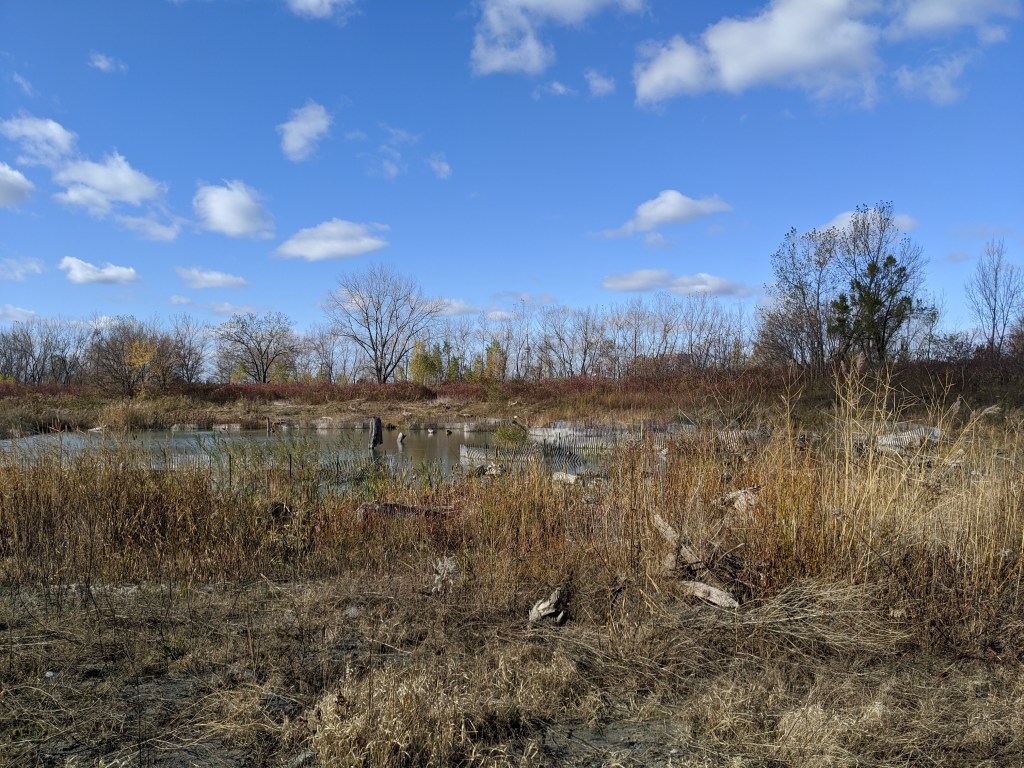
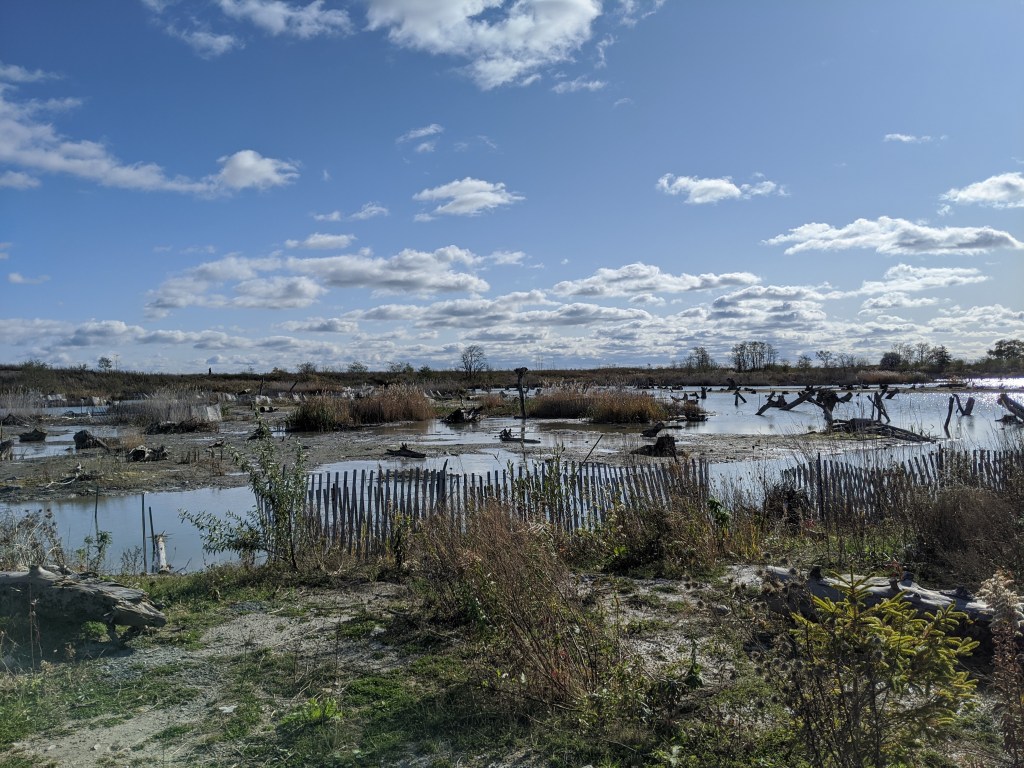
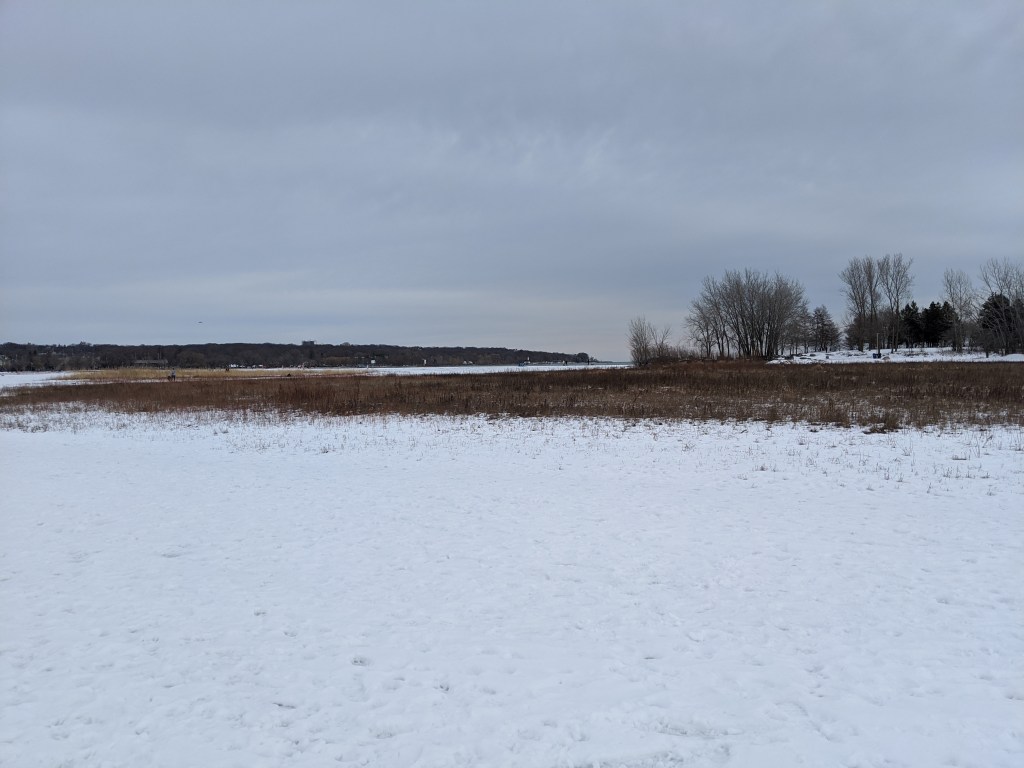
It is early afternoon, and the day is cool, crisp, and bright. I am standing on a foot-beaten path, gazing at the pools filled with dead branches and debris. There are two herons circling; they swoop past me and settle somewhere behind the tall grasses that obscure much of my view. My surroundings are almost noiseless beyond the whisper of the ryegrass swaying in the wind. A song bird chirps a few notes. Somewhere else, a bullfrog croaks.
I arrived here first by bike, taking the waterfront path west, and then south towards the Leslie Spit bike path. On my way, I passed industrial dump trucks and transports, whose constant movement creates a permanent fog of brown dust. Today, the pathway to Tommy Thompson Park is almost completely obscured – the parking lot has been dug up for repairs, and it took me a few minutes to find the temporary entrance, which is marked haphazardly with construction cones and snakes through the industrial chaos. A few more minutes on my bike, though, and the noises of the city fade until almost mute.
I passed the official entrance into the park, currently unmanned, as it’s late in the year, and afterwards I coast with relative peace. I smile at a sign – PLEASE BREAK FOR SNAKES – and although my chances of meeting a snake are slim today, I still find myself scanning the road with a kind of vigilance.
Coming here, I passed the occasional jogger, hiker, or cyclist riding leisurely down the trail, and one called out to me while I was snapping photos of a sign: “Photographing?” he said, “right at the end there’s a little place off to the right. Lots to see there.” I shouted my thanks, and he rode on.
Now I step quietly, my bike resting in the grass. By the shore, the waters are so still they seem nearly untouched – the drop in temperature from the night before has left ice floes along the banks. I ask my púca* what he likes, while watching a flock of gulls stream by. He shrinks away and I’m unsure why. This open, treeless place of birds seems to leave him without confidence. He hops towards the water to take a look at its glassy waters.
What about your little paws? I ask, Aren’t they cold? He retreats to me and I shiver: they are indeed very cold.
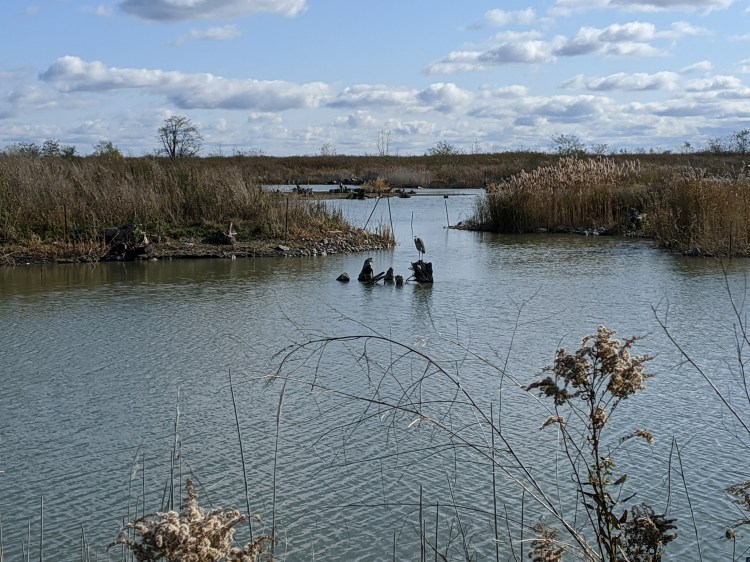
I pause along the path to take a photo – one of the herons has settled on a perch in the waters on what looks like the upturned roots of a fallen tree. I sense the tension in its sharp turn to watch me, and seeing its unease I make it quick. The heron springs into the air as soon as I put away my phone, circles the ponds, then dips out of sight.
Relationships
Tommy Thompson Park, known more informally as the Leslie Spit, has always been described to me as a place for biking, birds, and playing with garbage. “But that’s what it’s called!” A friend of mine once exclaimed, after a group of us snickered at ‘Garbage Island’, “People go there to make sculptures out of garbage!”
The Leslie Spit is known for its reputation for being an industrial dumping ground – the southern shores are often littered with broken bricks, tiles, twisted metal, and other small oddities too deteriorated to resemble the materials they originally came from. I regret to admit I have yet to add to this garbage mosaic myself, but I’ve enjoyed snapping photos of the twisted, absurd, and often uncanny creations other people have built out of the materials at hand. The Leslie Spit is often described with a sense that they’ve just left it to be, a site for leaving industrial rubble and experiencing unmanaged wilderness.
My personal relationship to Tommy Thompson Park is one connected through friendships. I was first introduced to the Leslie Spit by a friend who was teaching me to cycle in the city, and it was our end destination for a ride through Toronto’s east end. I was fascinated to find layers of bricks and metal just… left here, for anyone to touch, move, or build with. My friend shrugged – they’d seen it many times before.
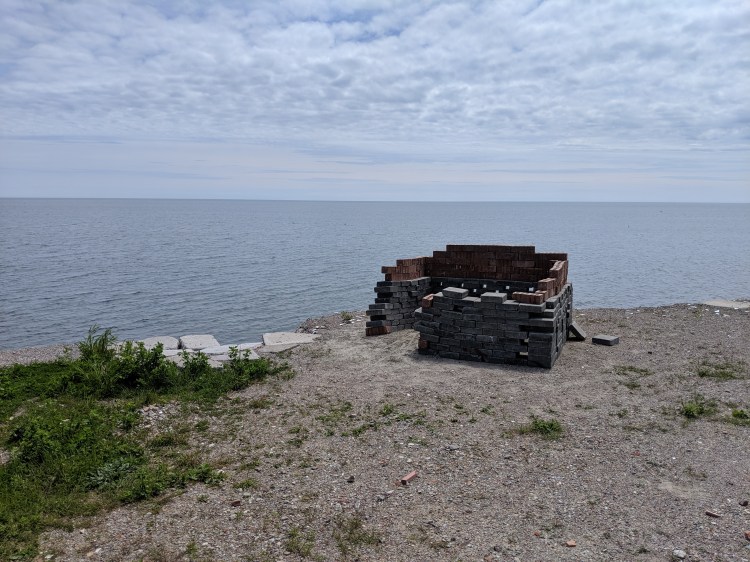
I visited The Leslie Spit on my own this past summer, and was barred from crossing the ‘floating bridge’ that connects the northeast part of the park to the southwestern peninsula – the lake had risen to a dangerous level, and the path was flooded. I doubled back and wound through paved and beaten paths until I found myself suddenly exposed to the waterfront, surrounded by piles of discarded brick. The scene struck me as some surreal kind of playground, like an oddly rendered Minecraft map**. Someone (or someones) had even built up a bit of a brick structure, overlooking the cliff out towards Lake Ontario. It seemed like people, similar to the birds, had been left to play how they see fit.
Critical Analysis: Psychogeographies of the Spit
The concept of psychogeography, which Debra Shaw describes as “a performance of the urban designed to expose and subvert the disciplinary mechanisms of built space” is a kind of urban exploration that ‘jolts’ one out of their everyday urban routine by calling attention to play (2018, 167). Taking the form of ‘drifting’, or wandering through the city, urban ‘spelunking’, or parkour, for example, one can experience their urban environment in new ways, and illuminate parts of their urban environment which may otherwise be hidden or missed (Shaw 2018). Although psychogeographies primarily spring from the ‘derive’ of Situationist International, which emphasized wandering through the city (Sadler 1999), the Leslie Spit’s garbage playground can represent a kind of psychogeography as well – by inviting people to play with the refuse – or, memories – of their city, on a personal embodied level, to reimagine their urban environments. So, what do the memories that make up Tommy Thompson Park, or the Leslie Spit, have to teach us?
Famously, Tommy Thompson Park is a man-made landmass that has been constructed from the ‘clean fill’ of Toronto’s urban waste: rubble from demolished buildings, subway construction, and other industrial leftovers, beginning in 1959 and still continuing today (Foster and Fraser 2013; Ports Toronto n.d.). Originally intended to form additional docking for ships for an anticipated boom in port activity that never arrived, the Leslie Spit formed what The Toronto and Region Conservation Authority refers to as an “Accidental Wilderness” after plants and animals developed their own ecologies on the peninsula (n.d.). This “let it be” mentality is what, ironically, continues to inform our anthropogenic management of the park, which includes reforming its landscape and taking active steps to manage its animal populations (Foster & Fraser 2013). Considering this, the rubble that constructs Tommy Thompson Park can teach us the ways in which urban processes and natural processes work not against each other, but interdependently with one another. The “broken concrete, ceramic, brick, and porcelain” that we experience at the Leslie Spit gives us almost 60 years of urban history to play with, consider, and ultimately create new forms with (Foster & Fraser 2013, 212).
On the other hand, Tommy Thompson Park also embodies another kind of remembering. The peninsula has also been constructed with dredging materials from Lake Ontario, including materials from the Ashbridge Wetlands and deposited silt from the Don Valley River (Desfor & Bonnell 2013). The Ashbridge Wetlands once covered the portlands, and extended into the lake, and was one of the largest wetlands on Lake Ontario (Desfor & Bonnell 2013). Once referred to as the “despised region known as ‘The Marsh’” by an article in the Toronto Globe in 1907 (qu. Desfor and Bonnell 2013, 175), the Ashbridge wetlands now mainly exists in the form of displaced land and memory. When we visit Tommy Thompson Park, we’re not only experiencing man-made wilderness: we’re also walking on the remains of the Ashbridge Marsh, and the displaced river silt of the Don Valley River, which was straightened in even earlier ‘improvement’ projects of the 19th century (Desfor & Bonnell 2013). In this way, Tommy Thompson Park and the Leslie Spit become psychogeographies for us to re-experience these displaced memories, and reflect on our interdependent relationship with the natural processes around us.
However, the Ashbridge Wetlands isn’t completely displaced. A small sliver of the Ashbridge Marsh still remains, in the form of a small recreational beach – The Woodbine Beach.
A Moment of Reflection: Returning
Originally I had intended to visit the Spit one more time to reconsider my relationship to it. Instead, I found myself again at the Woodbine Beach.
Late one night, I was making my way to our closest grocery store. My púca nudged me, reminding me of unfulfilled promises to take us for our weekly walk to the Woodbine Beach. Somewhat reluctantly, I detoured, wandering towards the beach. This day, I followed – he led me with a bread trail of glimpses of feeling, away from our usual route east along the boardwalk, instead towards the winding paths that explore the small, rocky western peninsula. We stopped here to listen to the waves, and to look out from the shoreline – to watch the lake and the sky disappear together into the dark. As I turned to leave, I scanned the shoreline of the Woodbine Beach, and it dawned on me – these were the remains of the Ashbridge Marsh. Suddenly struggling to catch my breath, I circled a large patch of standing water sprouting with long grasses. Momentarily, I stopped, to spin and take in my surroundings. All around me was land – it felt so huge, and this was only a sliver. Everything came into view, if only for a moment – the Wetlands would have stretched as far as I could see, marshlands instead of lake and buildings. What would that world have been like?
Notes
*púca are shape-changing fairies, who have an ambivalent, but often playful relationship with humans. They are of Irish/Celtic heritage (Breatnach 1993). They like to play tricks, but seem for the most part to not intend to harm, and can bring good luck as well as bad luck.
** Minecraft is a trans-platform worldbuilding videogame known for its blocky aesthetic (Perrson 2011).
Bibliography
Breatnach, Deasún. 1993. “The Púca: A Multi-Functional Irish Supernatural Entity.” Folklore 104 (1/2): 105–10.
Desfor, Gene, and Jennifer Bonnell. 2013. “Planning Nature and the City: Toronto’s Lower Don River and Port Lands.” In Urban Explorations: Environmental Histories of The Toronto Region, edited by L. Anders Sandberg, Stephen Bockling, Colin Coates, and Ken Cruikshank, 165–88. Hamilton, Ontario: Wilson Institute for Canadian History.
Foster, Jennifer, and Gail Fraser. 2013. “Predators, Prey and the Dynamics of Change at the Leslie Street Spit.” In Urban Explorations: Environmental Histories of The Toronto Region, edited by L. Anders Sandberg, Stephen Bockling, Colin Coates, and Ken Cruikshank, 211–26. Hamilton, Ontario: Wilson Institute for Canadian History.
Persson, Markus “Notch.” 2011. Minecraft. Stockholm, Sweden: Mojang.
Ports Toronto. n.d. “Leslie Street Spit | PortsToronto.” Accessed November 29, 2019. https://www.portstoronto.com/port-of-toronto/harbour-maintenance/leslie-street-spit.aspx.
Sadler, Simon. 1999. The Situationist City. Cambridge, Massachusetts ; London, England: The MIT Press.
Shaw, Debra Benita. 2018. “Posturban Psychographies.” In Posthuman Urbanism: Mapping Bodies in Contemporary City Space, 167–80. London; New York: Rowman & Littlefield International Ltd.
Toronto and Region Conservation Authority. n.d. “About.” Tommy Thompson Park | Leslie Street Spit. Accessed November 29, 2019. https://tommythompsonpark.ca/about/.
 A Worn Journal of Fieldnotes